690. De Imperio Cn. Pompei by Cicero. Background. The more success the Republic had, the more demands increased for involvement over seas. Leaders of the Republic saw the need to become more and more involved in matters beyond Italy, sometimes due to pressure from those who sought fame, but also due to a genuine desire to protect Italy and allies of the Republic. Political infighting and reluctance also caused the Republic to neglect the interests and needs of those who appealed to the Republic for help. Pirates, in the absence of Republic involvement, had come to control large portions of the Mediterranean Sea. In fact at times food was scarce. The Republic faced a crisis. Pompeius was selected to clear the seas of Pirates. He did this in 45 days. A feat which surely would rival modern capacity. Another long standing crisis persisted in the east (modern day Turkey and beyond). Three commanders had already been sent against Mithridates. He had maneuvered for years to place himself at the head of a powerful state in opposition to the Republic. The Republic's problems with the Social Wars, Sulla's civil wars, and political conflict had allowed Mithridates to recover and flourish, in spite of the fact that three commanders had been sent against him. A Tribune, Manilius, put forth a bill to appoint Pompeius as commander to set things right in the east. The Roman people had endured Social Wars, Civil War and intense political contests, and the cost in lives and money to deal with Mithridates. It appears that they were not interested in another war.
The speech. So when Cicero gives this speech to the Romans assembled, it is not pro forma in the sense that he talks, the law is passed and a general is sent. That modern view has done much to distort the accomplishments of the Senate and Romans/Italians.
Cicero makes the point that the Republic had defended her allies against Carthage, Philip, Antiochus and others. Cicero makes an interesting point when he says that the taxes collected from most allies barely cover the cost of protection but Asia (Turkey and beyond) is the source of wealth needed to defend the empire. It seems that many citizens had little interest in the fate or needs of those people and companies who collected the taxes. Cicero carefully explains business men have invested large sums in setting up offices, staff, networks to do this work. They collect the revenue. That revenue is sent to Rome. That is the money used to fund, among other things, the defense of the empire. Cicero explains that if turmoil occurs in Asia, farmers in the area plant less due to fear of loss, business people there cut back for the same reasons, Republican investors will not put money into a losing project. Then those taxes are not collected. Money does not come to Rome. Investment locally in Italy falls because money becomes tight and interest rates increase. Cicero points out that the finances in the Forum depend on tranquillity in Asia. Cicero connects the security of Asia to the security of Italy. In fact he makes the case that citizens have the obligation to defend their honor, their allies and revenue and those citizens who risk their lives for the Republic. All of these are bound together, one is not separate from the other. (14,15,16,17)
Cicero throughout gives a tutorial on proper conduct in governing the empire and in the process gives the purpose of empire:
A leader must practice restraint, pursue moderation, be accessible, open to complaints, possess a sense of humanity, practice that war ceases when weapons are dropped, display courage, be persistent. These qualities create prestige which will restrain those who would do damage to the Republic. These qualities create prosperity.
The law passed. Pompeius brought an end to Mithridates.
Two things struck me about this speech. One- his honesty in assessing the situation, two- his constant reference to operate under high standards at all times.
Wednesday, December 11, 2013

Wednesday, December 4, 2013
#3. KIDS ARE IN THEIR SEATS- WHAT TO DO?
#3. After seating, after handing out books (on the same day) I would pick up flash cards with Latin vocabulary on each. Each word was shown to the students and they were asked to imitate my pronunciation of that word. I would go through 7 to 8 cards, both sides.
Then I would say, "Take out a half sheet of paper and number 1 to 6. Put your name at the top."
Now most teachers do nothing on the first day, I learned long ago. Kids by the time they arrived in my class were tired and bored with rules and regulations and threats. So in they come, are seated, books are handed out, we go through some cards and then- take out a sheet of paper and number one to six. Some will not have paper, pencil. I always purchased pencils, sharpened those and had on hand. So now everyone has pencil and paper. They are worried, maybe even scared. I always stood on a box a student once made.
I ask "Are you ready for a quiz?" Some will look concerned. I ask "Would you like to review those words for the quiz?" In 30 years that I did this it never failed "yeh, yoh, ok". I would ask "What do you suppose the magic word is?" Finally someone would say "please."
I rarely asked individual students for an answer. Each class answered as a mob. If they were not loud enough, I would say "I can not hear you!" (In a loud voice). Then we would go through the 6 to 8 words, slowly at first and then faster and faster.
Then I would ask, "Are you ready?" "Yes" came the reply. Then I would go through the cards one more time and then give the quiz.
What is the point here? By doing this, students separate your class from most if not all of the others. They have already learned that courtesy is important- both ways. They know that you know who they are. And in spite of what they have heard from other sources, they realize that Latin can be easy and fun.
This first test always told me a great deal. Most students scored very high, very high. But those who struggled let me know who needed more push or maybe who was lazy, or scared. Or lacked ability. Either way this technique puts the teacher in charge on the very first day.
Then I would say, "Take out a half sheet of paper and number 1 to 6. Put your name at the top."
Now most teachers do nothing on the first day, I learned long ago. Kids by the time they arrived in my class were tired and bored with rules and regulations and threats. So in they come, are seated, books are handed out, we go through some cards and then- take out a sheet of paper and number one to six. Some will not have paper, pencil. I always purchased pencils, sharpened those and had on hand. So now everyone has pencil and paper. They are worried, maybe even scared. I always stood on a box a student once made.
I ask "Are you ready for a quiz?" Some will look concerned. I ask "Would you like to review those words for the quiz?" In 30 years that I did this it never failed "yeh, yoh, ok". I would ask "What do you suppose the magic word is?" Finally someone would say "please."
I rarely asked individual students for an answer. Each class answered as a mob. If they were not loud enough, I would say "I can not hear you!" (In a loud voice). Then we would go through the 6 to 8 words, slowly at first and then faster and faster.
Then I would ask, "Are you ready?" "Yes" came the reply. Then I would go through the cards one more time and then give the quiz.
What is the point here? By doing this, students separate your class from most if not all of the others. They have already learned that courtesy is important- both ways. They know that you know who they are. And in spite of what they have heard from other sources, they realize that Latin can be easy and fun.
This first test always told me a great deal. Most students scored very high, very high. But those who struggled let me know who needed more push or maybe who was lazy, or scared. Or lacked ability. Either way this technique puts the teacher in charge on the very first day.
#2. HOW TO HAND OUT BOOKS!
#2. On the first day after seats have been assigned, hand out the books/texts for class. Hand a book to a student, pause and wait for that student to say something before moving on to the next. Think about it, what do we say when someone hands us something? We say- thank you. So pause, wait for the student to respond. If they do not respond, do not lecture (kids hate that), remove the book and move on to the next student. Place the book in front of the next student. If still no response, ask what a person says when they are given something. That student will say thank you. Then hand a book to the next student and pause. After they say thank you, each time you can say- welcome. What do we achieve with this? Without lecture, blah, blah, blah, the students know that courtesy is important. I did the same with tests or anything I handed out. There are some students, more than I would like, who live in a home where thank you, please are nonexistent. Teaching courtesy makes a classroom friendly and pleasant. Trust me it worked for 30 years. Oh, of course there were some students who tested the system each year. I would hand out tests, pause and wait for a thank you. If none came, I removed the test and went to the next student. Passing out the tests puts the teacher in the mix, allows a view of each desk and personal contact with the student.
Of course it is essential for the teacher to say thank you when students hand in something. The purpose of this is not to dominate the students but instead create a somewhat paternal relationship. After all the law says teachers are in loco parentis= in place of a parent.
The benefits increase a thousand times come February when other teachers are endlessly complaining about students. However, in your class courtesy reigns and you are happy to see students come through the door. In fact many times Guidance would mention to me how courteous "my" students were. I taught in high school. My students? Yet, students in my class gained a reputation for courtesy. Go figure.
This, also, just as rule #1 creates a pleasant atmosphere for both the student and the teacher. Believe me discipline is much easier when names are known, relationships are based on courtesy and students want to enter.
Of course it is essential for the teacher to say thank you when students hand in something. The purpose of this is not to dominate the students but instead create a somewhat paternal relationship. After all the law says teachers are in loco parentis= in place of a parent.
The benefits increase a thousand times come February when other teachers are endlessly complaining about students. However, in your class courtesy reigns and you are happy to see students come through the door. In fact many times Guidance would mention to me how courteous "my" students were. I taught in high school. My students? Yet, students in my class gained a reputation for courtesy. Go figure.
This, also, just as rule #1 creates a pleasant atmosphere for both the student and the teacher. Believe me discipline is much easier when names are known, relationships are based on courtesy and students want to enter.
#1. HOW TO GET KIDS TO LIKE YOU!
#1. On the first day after seats have been assigned, take the time to memorize the name of each student. I always learned their names row by row in order. Then I would practice diagonally, from front to back and back to front. It does not take very long and then the next day as the students walk through the door, address each kid by name. They love it. After a while they will tell you that this or that teacher after 5 weeks, ten weeks, 13 weeks still does not know their name. Students hate that. Students/kids will respect you for the effort and the care. Teaching is subject oriented BUT it is almost essential to form a relationship of respect, consideration and paternal affection. This is also a big step toward quality discipline.
Tuesday, December 3, 2013
Lucius Marcius Philippus and President Obama
Lucius Marcius Philippus and President Obama
President Obama at his State of the Union, January 27, 2010, made a strongly worded remark about the Supreme Court. The Supreme Court had recently handed down a decision allowing corporations to contribute money to election campaigns. When the President's remark was made, numerous supporters stood around and behind the seated Supreme Court members and screamed and cheered. By protocol members of the Court are expected to remain nonpartisan. Chief Justice Roberts on March 9, 2010, while talking to law students at University of Alabama expressed concern about such a remark in a setting which is supposed to have dignity and decorum.
It occurred to me that Chief Justice Roberts, within bounds of Supreme Court etiquette, was making a defense of the Court's dignity. As the Chief Justice, he felt in his opinion that there was a need, in the face of, what he considered, blatant outright denigration of the Court's standing, to come to its defense.
As I read this incident, something came to me which I have read several times in Marcus Tullius Cicero's De Oratore. The story concerns Lucius Marcius Philippus, one of the consuls at the time (91 B.C.) and Lucius Licinius Cassus, a former consul and teacher for whom Cicero had undying respect. The time is different, the situation is different but there is a connection concerning the protection of dignity and proper protocol. So here is Cicero's account of the incident (De Oratore III. 2-5):
The Consul, Philippus, was not happy with the Senate's stand on matters before the house. He was meeting with serious resistance. The Senate, apparently, adjourned without resolution. Senators went home. Philippus, irate, delivered a speech, laying out his anger and complaints not to the Senate but to the public in a public assembly. He did not simply criticize the Senate but belittled its standing.
In public assembly Philippus said among other things that he must look elsewhere for an advisory body, for with this Senate he could not carry on the government. When Crassus heard of the speech, he returned to Rome. On the morning of September 13, Marcus Livius Drusus, as Tribune, called a meeting of the Senate. Crassus came, Philippus came and soon the Senate house was stuffed to overflowing. Drusus listed his complaints about Philippus and then made a motion for a vote concerning the violent attack which Philippus had made publicly against the Senate on the previous day.
Crassus, Cicero reports, was astonished that a Consul, in public, made a vicious attack on the Senate. Crassus was further angered that a Consul, who ought to be a faithful parent and guardian of the Senate, plundered the cherished dignity of the Senate like some looter. "There must be no surprise", said Crassus, "when this consul has damaged the Republic with his policies, if he should reject the Senate as an advisory body" (since it no longer suits his purpose).
With this, says Cicero, Crassus had enraged Philippus ,a man impetuous, bold and learned, too. Philippus could restrain himself no longer; he jumped from his Senate seat and commenced to coerce Crassus by seizure of his property, if he failed to relent. (Such a move by Philippus treated Crassus not as a fellow Senator but as someone to be ordered about.) The exchange heated up quickly. At that point Crassus replied that, since he did not view Crassus as a Senator, he denied that he, Philippus, was a Consul.
"Do you really think, when you regard the Senate as something to be controlled by intimidation, and in a public assembly you ruin its authority, that I can be intimidated with threats of seizure? If you wish to coerce Crassus, you must not destroy his property; you must rip out his tongue; as a matter of fact although his tongue has been removed, with breath alone my liberty will repel your obscene willfulness. "
It seems that Philippus mocked the standing of the Senate in the wrong setting and in a demeaning way, at least in the opinion of Crassus. Crassus felt that Philippus had not only done damage to the Senate's ability to have credibility with Roman citizens (and consequently more difficult to perform its duties) but had failed to treat an ancient government body with the respect it deserved in a public setting.
Crassus at the end moved a resolution which declared that the country should be confident that neither the advice nor loyalty of the Senate was lacking. The motion passed with ease.
Decorum is a complex term but the swift route to the heart of its meaning is that there is a right place and a wrong place to say something and a right time and wrong time. It may be that Chief Justice Roberts was suggesting that the President express his thoughts in the proper setting and at the proper time without damaging the Court's standing.
President Obama at his State of the Union, January 27, 2010, made a strongly worded remark about the Supreme Court. The Supreme Court had recently handed down a decision allowing corporations to contribute money to election campaigns. When the President's remark was made, numerous supporters stood around and behind the seated Supreme Court members and screamed and cheered. By protocol members of the Court are expected to remain nonpartisan. Chief Justice Roberts on March 9, 2010, while talking to law students at University of Alabama expressed concern about such a remark in a setting which is supposed to have dignity and decorum.
It occurred to me that Chief Justice Roberts, within bounds of Supreme Court etiquette, was making a defense of the Court's dignity. As the Chief Justice, he felt in his opinion that there was a need, in the face of, what he considered, blatant outright denigration of the Court's standing, to come to its defense.
As I read this incident, something came to me which I have read several times in Marcus Tullius Cicero's De Oratore. The story concerns Lucius Marcius Philippus, one of the consuls at the time (91 B.C.) and Lucius Licinius Cassus, a former consul and teacher for whom Cicero had undying respect. The time is different, the situation is different but there is a connection concerning the protection of dignity and proper protocol. So here is Cicero's account of the incident (De Oratore III. 2-5):
The Consul, Philippus, was not happy with the Senate's stand on matters before the house. He was meeting with serious resistance. The Senate, apparently, adjourned without resolution. Senators went home. Philippus, irate, delivered a speech, laying out his anger and complaints not to the Senate but to the public in a public assembly. He did not simply criticize the Senate but belittled its standing.
In public assembly Philippus said among other things that he must look elsewhere for an advisory body, for with this Senate he could not carry on the government. When Crassus heard of the speech, he returned to Rome. On the morning of September 13, Marcus Livius Drusus, as Tribune, called a meeting of the Senate. Crassus came, Philippus came and soon the Senate house was stuffed to overflowing. Drusus listed his complaints about Philippus and then made a motion for a vote concerning the violent attack which Philippus had made publicly against the Senate on the previous day.
Crassus, Cicero reports, was astonished that a Consul, in public, made a vicious attack on the Senate. Crassus was further angered that a Consul, who ought to be a faithful parent and guardian of the Senate, plundered the cherished dignity of the Senate like some looter. "There must be no surprise", said Crassus, "when this consul has damaged the Republic with his policies, if he should reject the Senate as an advisory body" (since it no longer suits his purpose).
With this, says Cicero, Crassus had enraged Philippus ,a man impetuous, bold and learned, too. Philippus could restrain himself no longer; he jumped from his Senate seat and commenced to coerce Crassus by seizure of his property, if he failed to relent. (Such a move by Philippus treated Crassus not as a fellow Senator but as someone to be ordered about.) The exchange heated up quickly. At that point Crassus replied that, since he did not view Crassus as a Senator, he denied that he, Philippus, was a Consul.
"Do you really think, when you regard the Senate as something to be controlled by intimidation, and in a public assembly you ruin its authority, that I can be intimidated with threats of seizure? If you wish to coerce Crassus, you must not destroy his property; you must rip out his tongue; as a matter of fact although his tongue has been removed, with breath alone my liberty will repel your obscene willfulness. "
It seems that Philippus mocked the standing of the Senate in the wrong setting and in a demeaning way, at least in the opinion of Crassus. Crassus felt that Philippus had not only done damage to the Senate's ability to have credibility with Roman citizens (and consequently more difficult to perform its duties) but had failed to treat an ancient government body with the respect it deserved in a public setting.
Crassus at the end moved a resolution which declared that the country should be confident that neither the advice nor loyalty of the Senate was lacking. The motion passed with ease.
Decorum is a complex term but the swift route to the heart of its meaning is that there is a right place and a wrong place to say something and a right time and wrong time. It may be that Chief Justice Roberts was suggesting that the President express his thoughts in the proper setting and at the proper time without damaging the Court's standing.
Monday, December 2, 2013
Temple of Portunus

the only surviving building in Rome seen by Cicero.
By Bill Prueter - 8/29/2008
Imaging delights some. Others are thrilled by catching live video moments. Both are legit, worthwhile and satisfying. Imaging cameras have remarkable ability to record colors and shading. What tool has sensitivity for millions of shades of intensity, colors and can negate temporary fluctuations in atmospheric disturbances? That tool is the human eye, an
organ which produces proteins at light speed to keep receiving photons of light in endless streams. The eye needs a partner. That is the brain. This awesome organ can manipulate information, sift out nonsense and synthesize previous images with those which smack of accuracy. I make the case for live observations at the scope and putting those views on paper.
How to get started.
Sharpen a pencil, any pencil. Take a chair, place it in front of the scope, any scope. Preferably point it at the moon. You can start with any object. But the moon has so many features to examine that any telescope will give interesting views and plenty to draw. If it is still daylight, makes no difference. In fact drawing in the daylight eliminates the need to worry about lighting, flashlights etc. Sit down and get comfortable. If the moon is high in the sky, take out a stool, maybe your child’s bathroom stool. Sitting is much more comfortable than standing. Use a diagonal, it is much more comfortable. You do not need an equatorial mount. Sit down, point the scope. Make enough magnification to allow a prominent sea or crater to display some features.
If you are going out at night, kind of dark, isn’t it? Take a flash light with you. Get a flashlight with a clip on it. Clip it to the hood of your sweatshirt, on the side near your ear. I found my flash light at http://www.zengineering.cjb.net/. They come with red or white bulbs. White light is great for the Moon. If it is warm, wear a thin hood. You can, if you wish, go to the web and read other methods for lighting, but they are going to add equipment and trips back to the house and more expense. Some seem to me very labor intensive. Check my photo, it may give you an idea, even a better one.

What paper should be used?
In the beginning - any paper. Take something along to support the paper. After a while, get a note book. I really like Sketchbook by Fusion. The paper is very heavy (100 lbs. weight). It easily resists dew and dampness. It also endures numerous erasures. It also has a nice smooth surface which will allow for nice details. One side is lined, the facing page is blank. I put my information on the lined side. What I have observed, how long, filters used, magnification, date etc. Some papers are bumpy and do not allow accurate drawings.
Begin to draw what you see. Take some time to look at the object. Select some feature which attracts your attention. Let us say, it is the crater, Plato. What is the shape? Are there any mountains near by? Is the floor of the crater smooth, rough? What do you notice about the rim which goes around the crater? Are there breaks in the walls? Continuous ridges? Can you see any craters in the crater? Dark spots, light spots? Pick out some features. Draw them. Use your pencil to show areas which are darker or lighter. You may want to make notes. Be sure to record the time and date. The notes may take on a simple description. Such as: darker here, lighter there, really dark, in between. Use this drawing as a guide to make a final drawing of what you see, once you go inside. Worry more about drawing size and proportions accurately rather than making it look good.
Keep your expectations low. Your drawing may not look like much. But cherish it, and make sure you keep it.
Here are two of my earliest drawings:
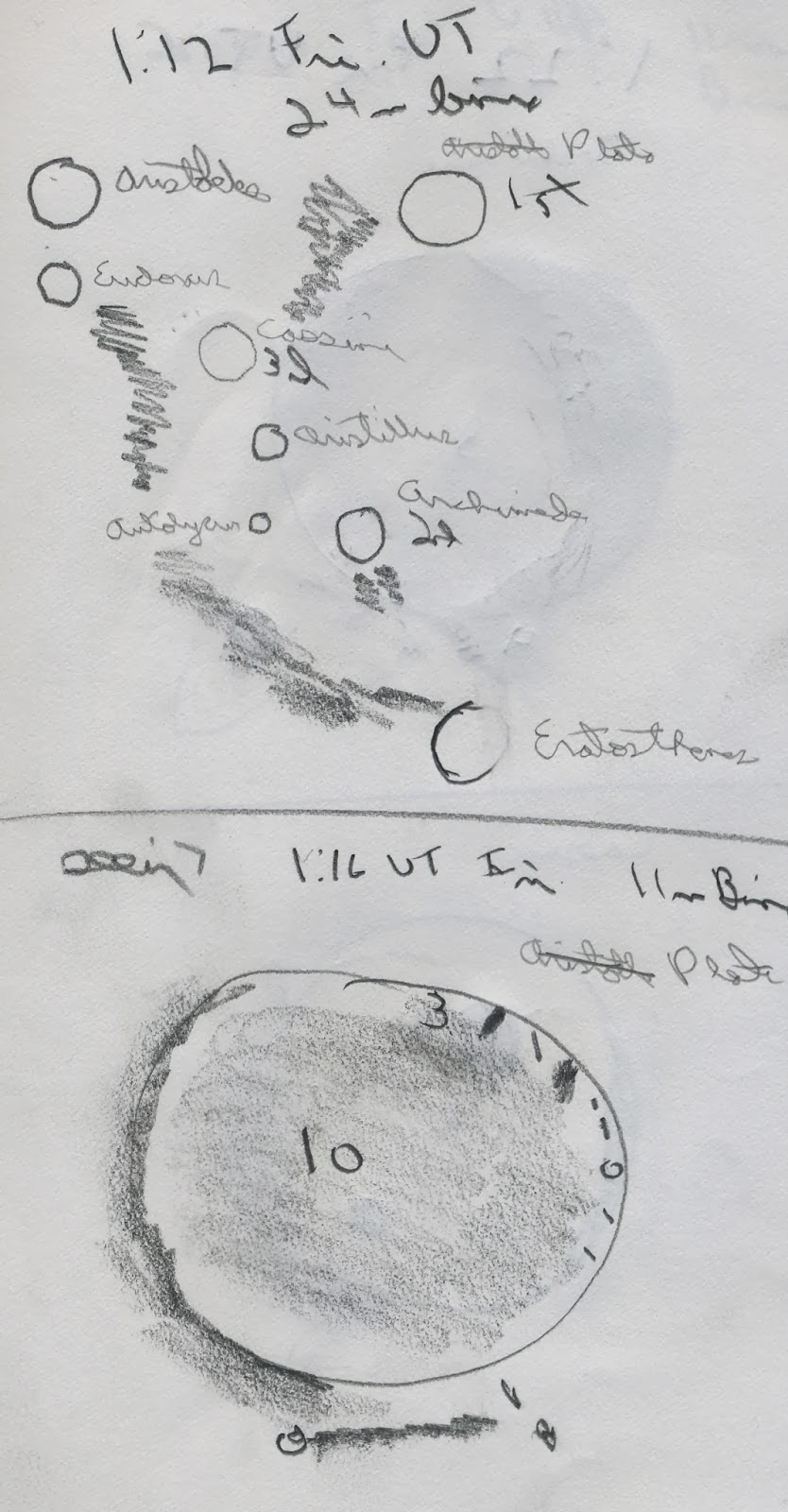
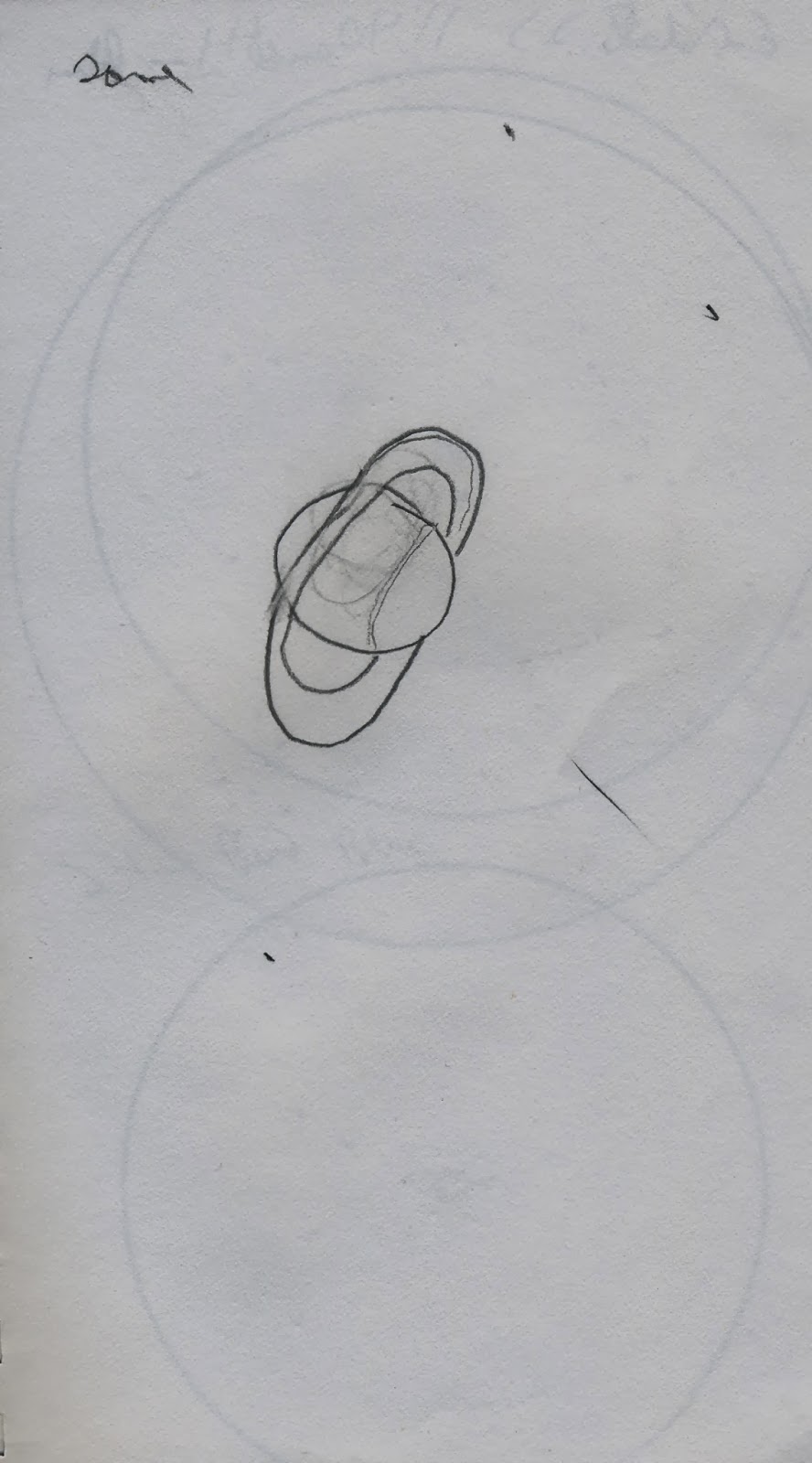
Note how simple it looks. In fact childlike. Some might be tempted to bury such efforts. Big mistake. Keep drawing and once and a while go back, look at the early stuff and then begin to realize the advances you have made. Can’t do that if you chuck what does not measure up to your hopes. There are a number of reasons these drawings do not look like much:
1. I needed to develop my drawing skills. Practice will take care of that.
2. I needed to learn to look for details. This requires training. That means looking frequently through the telescope. I have sometimes noticed that my drawings rival in detail what telescopes reveal using digital imaging.
3. I also needed to learn to connect what my mind saw with care in drawing.
4. I also needed to learn to be more patient. That is one more reason to have a comfortable position to observe.
Books.
I am not a big fan of astronomy books which discuss how to draw. I have purchased some. They may be what you need or want. Buy them. For me some have too much of an artsy approach. Sure, it sounds good but when I am done with a sentence, I wonder just exactly what good lies therein and what it means. Association of Lunar and Planetary Observers (ALPO) highly recommends a book entitled: Introduction to Observing and Photographing the Solar System by Dobbins, Parker, Capen. This book is out of print but used copies are available. It tells you what to look for in Solar System objects (planets, sun, moon, comets, asteroids). It also explains how our atmosphere works. This has turned out to be a very big plus. As a result I learned about weather. Clouds are not necessarily the enemy. There are even times where the leading edge of a cloud brings great stability to quality view. I also learned that the moon has great wonders to offer, mysteries and joy. If someone had said when I received the book that this is the interpretation of the atmosphere and approach it would give to observing, I would have been incredulous. Just another example in my life of the endless set of connections between one so-called disparate subject and another. It also discusses what to look for on Mars, Jupiter, Saturn etc. The chapters on photography are dated but that is not the reason I purchased it.
ALPO also provides a manual for learning to draw. Its instructions show you how to make what they call intensity drawings. Numbers are used on a scale of one to ten. One is complete darkness, ten is brightest. These are called intensity numbers. The others are shades in between. These numbers are placed in those areas of your drawing which will indicate how dark that area will be drawn in your final drawing. To do this will be handy to buy drawing pencils which have different hardness. Different shades are possible with different number of pencil. I recommend buying at an art store 6B, H and 6H. You may also want an eraser. I suggest Papermate’s Tuff Stuff Eraser Stick. It works well and allows fine line erasing. This book has some weaknesses which are partially mitigated by its briefness.
Look at an example of an intensity drawing I have made. The first is an early one; the second is more recent.

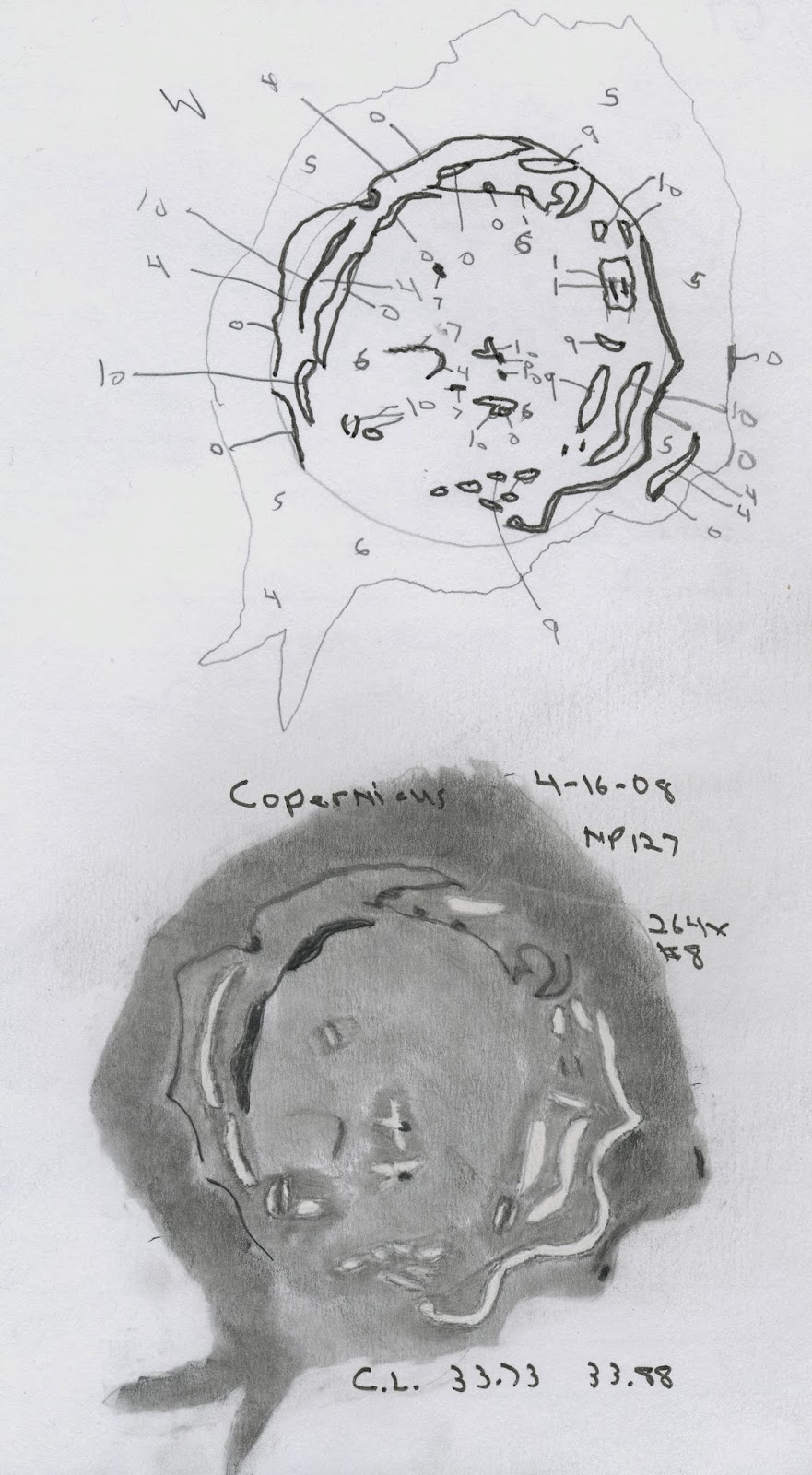
There are several factors involved in intensity drawings. I think that the following two are the most important: learning to gauge which area is the lightest, which the darkest and those shades in between the two. The best cure for poor drawings is to practice. The other is looking with care for details. It is often the case for me that I notice something after I have already been looking at the object for 10, 15, 20 minutes. I look around, then, the next view something seems to pop out that simply eluded me before. It could be that the atmosphere cooperated and gave me great clarity for a moment or two or I simply missed the feature.
Part of the beauty, in my humble judgement, is that you do not need to be out there all night. There are those who do that, fine. But for those who have trouble doing this, have jobs or can not fit such into their life, go out to make one drawing, if that is all of the time you have. You can make a nice rough draft with intensity numbers and features you have noticed in an hour or hour and a half. You still have an evening and actually will be refreshed for the next day, since this activity will sever those ties with what has been bugging you. It will, in the still of the night, energize and bring meaning to life.
If you need reasons to continue drawing, read Peltier’s Starlight Nights. Follow that up with The Friendly Stars by Martha Evans Martin. These will not even mention drawing but they will place stars and the universe in context of life and seasonal events. One of the many fascinating moments in Peltier’s book was when he mentioned how much he enjoyed hearing owls, birds, rustling critters during an evenings observation. There is more to this than just drawing, far more. The Friendly Stars was the book Peltier read when he was a kid which spurred him to study the sky in the first place. The woman who wrote it looked upon the stars as companions for flowers and plants as the seasons turned. Too much of astronomy seems to smack of memorizing lists and treating celestial objects as bugs under glass. Observing puts you with the bug. Read these books, if you wish, and maybe what you see will reflect worlds which bear a connection to life here on earth. This book is also out of print but used copies are available. Your local library, if you live in a state with a quality library system will be able to fetch a copy for free. Of course, you will need to return it when done.
Here are some later drawings:
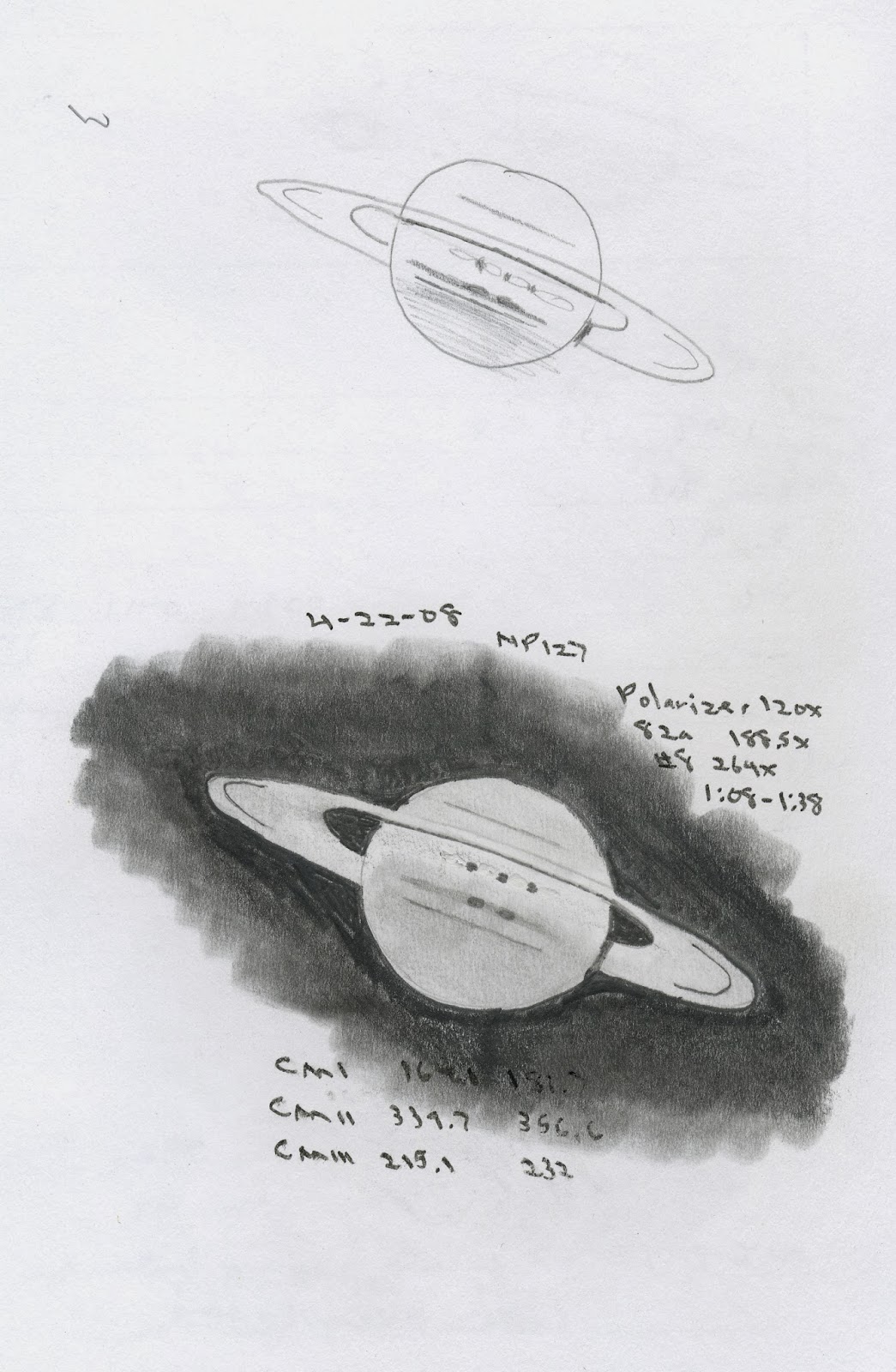
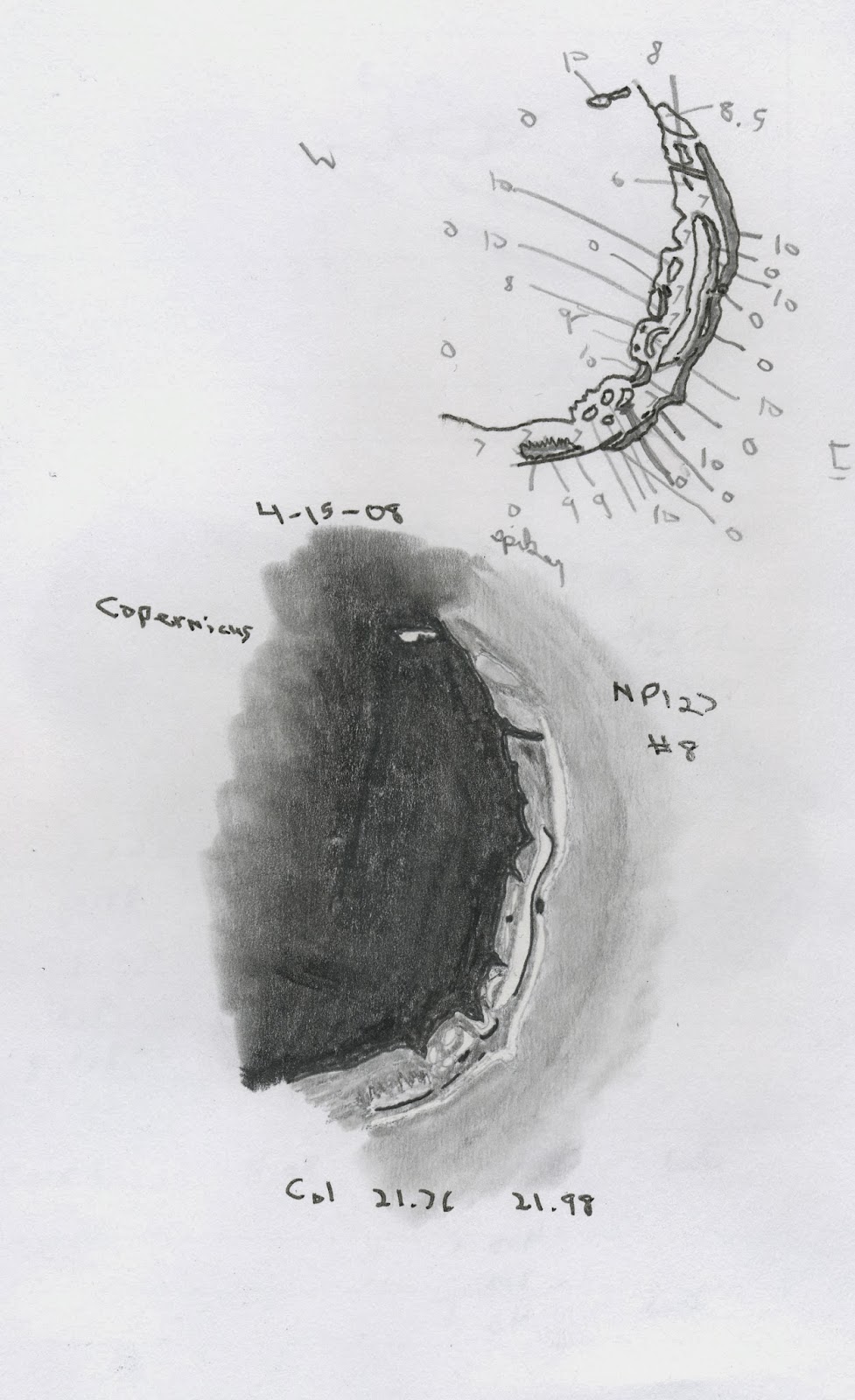
These drawings show more detail. Far more than the first ones. As you become more adept at drawing, you will want to include more information. How long did you observe while drawing? What was the temperature that night? This may help in planning proper clothing.
Averted vision.
What is this? The human eye and brain together are an awesome pair. The eye has a spot in the middle of our sight which is called the blind spot. In some ways our peripheral vision is stronger. Let us say that you are looking at Jupiter. Near by there are always three or four Galilean moons. Bend your eye to one of the moons, pick one furthest away. You will after time, notice features on the planet’s surface which you did not notice when looking directly at the planet. This takes practice. It takes time.
Clothing
There are some nice private websites which have wonderful information about how to dress for observing. Layered clothing is the best way to go. You will need to dress for temps about 20 degrees less than the actual ambient temp. So if the thermometer outside says 50 degrees, better dress as though it is 30 degrees. I have found that in the summer a light hooded sweatshirt is nice to wear- I clip my flashlight to it and it keeps mosquitos away.
Altazimuth mount versus Equatorial Mount.
Altazimuth mount is lighter, therefore it is easier to carry, for those of us who lug our scopes outside. It, of course, must be adjusted frequently in order to keep the object in view. I do not find this a bother. In fact I enjoy directly perceiving how quickly the world turns. Keeps one humble and fully aware that life should not be wasted. Equatorial mounts will track an object, once it is aligned. If you have a permanent place for your scope and you simply go out, roll off a roof and you are ready to go, then set up time is not a concern. But if you haul out the equatorial mount (probably will not be able to carry it with scope mounted on it- too heavy), attach scope, then it has to be aligned at least well enough to allow tracking ability to be useful. Be careful with adding on too much equipment. Studies show that scopes which are too much of a bother do not get used very often, in fact less and less until not at all. Keep it simple. At least as simple as you can.
What type of scope?
Whatever you have will do just great. If you are going to purchase one, then I would consider a refractor. These are much easier to sight. Lighter and yes more expensive per inch of aperture. However, more frequent use will be made of a Scope easy to carry and set up. There are 76 mm and 85 mm used scopes which are available for very good prices. The most important consideration: which scope is the most likely to be used most often? Refractors do not need alignment. They are good to go as is. Used ones are available.
This leads to eyepieces.
Select eyepieces with wide field of view. These are more expensive but will allow a larger area of view, even under higher magnification. Better to have very few good eyepieces rather than a sack full of poor ones. Wide angle is a nice feature for finding objects and keeping track of objects even with an altazimuth mount. By the way stick with a wooden mount, if you can, these do a much better job of damping vibrations. Main rule with eyepiece: select one or those which offer ease of use. The idea is not to collect a raft of eyepieces. Astromart has a nice offering, frequently for quality eyepieces.
Filters.
Filters are presented as necessities for observing. This is somewhat deceptive. Much, much, much can be seen with just you, the eyepiece and your telescope. For me filters have been a tricky item to grip. I feel at the moment that it is best to become as proficient as you can drawing with what you have and then when plateau has been reached, start with a filter. Best start for me was polarizer. Non variable type. I have used it with success on Jupiter, Mars, Venus and the Moon. I did not find it as much of a benefit on Saturn. Too little light, at least at high magnification. I have a five inch refractor. Thus I do not have a tremendous amount of light gathering ability. Also be careful reading suggested filters for particular objects put out by manufacturers. The reason for this is that a darker filter on my scope will not allow enough light to reach my eyes. This same darker filter may be perfect in a larger scope. I have for example a #8 yellow filter (very light yellow) which works very well with my scope on Saturn, Moon, Mars and Jupiter. My blue filter is also very light (82a). I suggest approaching filters with caution. No need to hurry into something. You can see a whole bunch with just the telescope, eyepiece and the mind’s eye.
Binoviewing
A binoviewer uses two eyepieces of the same focal length. This allows both eyes to be used. It reduces eye strain. It also eliminates the need to squeeze one eye shut which becomes very annoying after a while. Because you are using both eyes the brain helps to use the information which your eyes gather to make features more clear. The brain will also help to eliminate floaters, as one eye helps to compensate for another.
Binoviewers are expensive but combined with comfy chair, a position which makes it easy to look through the scope and wide angle eyepieces, the experience can only be enhanced. If the money scares, then look for used ones. That is what I have. Also better to use it with very few high quality eyepieces, rather than several which are to be honest not worth the money. As long as you have about 100 X, it is impressive what can be seen. Wide angle eyepieces also mean that you can use higher power, still find an object and keep it in view even with altazimuth mount. Check reviews for binoviewers. Some do not seem to be very good. Some are very heavy. This may be a consideration based on the kind and quality of scope you have. Astromart has binoviewers for sale. These are used, so be wary. Astromart does have a nice evaluation system.
Drawing on the spot is so very pleasant. I have heard coyotes, tree frogs, critters amongst the leaves. I have been suspended in the heavens, watched shadows grow on the Moon in a single evening and I have seen Jupiter’s moon clear his shadow and pop into view, in a matter of minutes. The silent hum of night, the pleasant rustle of leaves, the beauty above breaks the distance and brings the heavens to walk with me. Grasping great distances is fruitless and oppressive. The key to grasping the universe lies in making a connection between the beauty of daylight, the passing of daytime color as night embraces and the ever increasing intensity of color in night time sky. The beauty of day fades into the glory of nocturnal color.
"A feeling of awe for the stars is not induced by exciting wonder at the expanse and mystery of the heavens, nor by burdening and oppressing the mind with the vastness that seems beyond all compassing thought, but by showing how the stars like flowers and trees are but parts of the visible beauty of nature which have their share in making "the perfect whole". (Martin, The Friendly Stars)
This and a whole lot more beckons.
Subscribe to:
Comments (Atom)